Home/Programs/Land Management & Fire Protection

Defending the world's greatest forests before, during & after fire.

A full-spectrum, science-driven wildfire defense system rooted in California's redwood country — built to protect the tallest living organisms on Earth and the watersheds, communities, and ecosystems that depend on them.

Our Purpose
The wildfires of the 21st century are not the fires these forests evolved to survive.— Why this division exists

The coast redwood is among the most extraordinary organisms ever to exist — living more than 2,000 years, growing taller than any other species, and storing more carbon per acre than any forest type ever measured. But a century of fire suppression, decades of fuel accumulation, prolonged drought, and the expanding wildland–urban interface have created fire behavior these ancient ecosystems have never faced.

Less than five percent of original old-growth redwood forest remains. Each catastrophic wildfire — from the 2020 CZU Lightning Complex to the megafires that now arrive with terrible regularity — pushes these irreplaceable ecosystems closer to permanent loss.

Our division operates a fully integrated, three-phase system: prevention before fire, rapid response during fire, and ecological restoration after fire — a model of distributed wildfire defense built for the realities of the modern American West.


The System

One mission, three fronts.

The best way to fight catastrophic wildfire is to ensure it never reaches catastrophic scale in the first place — and to rebuild stronger when it does.

1

Before the fire

Hazardous fuel reduction, defensible-space engineering to CAL FIRE and NFPA standards, forest restoration, and the access roads, fuel breaks, and water sources that turn a 10-acre incident into a contained one instead of a 100,000-acre disaster.

2

During the fire

Integrated response teams with drone surveillance, thermal hotspot detection, water tenders, mastication units, and mobile command — deployed alongside CAL FIRE and the U.S. Forest Service to slow spread and protect the highest-value trees and structures.

3

After the fire

Hazard-tree and debris removal, air-curtain burner disposal into biochar, erosion and slope stabilization, watershed and soil restoration, and replanting with local and champion genetics so the land recovers stronger than before.

Before The Fire

Land management & risk reduction.

Catastrophic wildfire does not begin with a spark. It begins with decades of accumulated fuels and degraded forest structure. We address risk where it actually originates — on the land itself.

Fuel reduction

Professional thinning, mastication, and chipping remove the ladder fuels, dense understory, and dead timber that drive extreme fire behavior — dramatically lowering flame heights.

Defensible space

Engineered defensible space around homes, communities, and critical infrastructure — the single most important factor in structure survivability during a wildfire.

Watershed & soil

We protect the watersheds, rebuild living soil, and remove invasives — restoring the open, fire-adapted forest structure California's ecosystems evolved with.

During The Fire

When the fire is moving, we move faster.

When a wildfire breaks out, the first hours determine the next thousand acres. Speed, coordination, intelligence, and capability are decisive.

Aerial intelligence meets a purpose-built fleet.

Drones map active fire perimeter and locate spot fires; thermal sensors find hidden hotspots invisible to the eye. On the ground, mobile command units, rapid-response trucks, water tenders, and mastication units shape how fire moves across the landscape — reinforcing frontline suppression in remote, rugged terrain far from hydrant infrastructure.

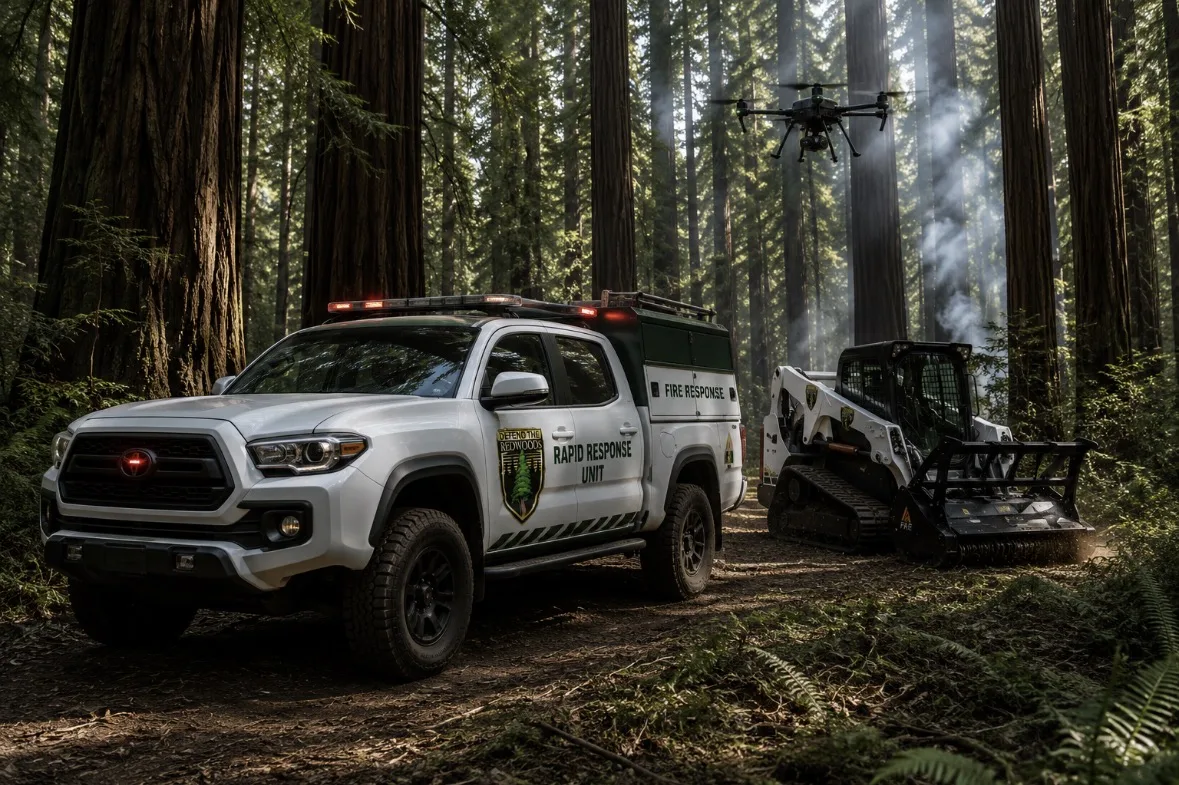
A Defend The Redwoods rapid-response unit, surveillance drone, and masticator working in an old-growth grove.
Statewide Response Network

The fastest wildfire response is the one that's already there.

We rebuild rural response infrastructure through the adaptive reuse of decommissioned fire houses — restoring active fire-response capability to the communities that lost it.

0
Operations stations active: Pescadero & the Mailliard Redwood Preserve.
0
Acres burned by the 2020 CZU Complex we now help restore.
0/0
Fire-season watch across the San Mateo coast and beyond.
0+yrs
Superintendent-level project management behind every operation.

Every dollar becomes work on the ground, in the forest.

We don't only protect redwoods — we actively work the land that protects them. Fund fuel reduction, active wildfire defense, burn-scar restoration, and the expansion of our statewide station network.